
Introduction
Most companies have no shortage of data. What they lack is context. A column called cust_id_v2 in one system and account_ref in another may describe the same customer, but nothing in the data says so. People guess, dashboards disagree, and AI tools do the same thing people do: they guess.
Two concepts help close that gap: the semantic layer and the business ontology. They are often mentioned together, and just as often confused. This guide explains what each one is, how they differ, and why using them together gives both people and AI a much clearer view of your business.
In short: a semantic layer makes data understandable. A business ontology makes the relationships between business concepts understandable. Together, they give AI the context it needs to investigate questions instead of just answering them.
What is a business ontology?
A business ontology is a structured model of the concepts, entities, events, and relationships that matter to your business. Instead of describing tables and columns, it describes things like Customer, Order, Product, Invoice, Payment, Employee, or Service Request, and how they connect.
For example, a simple sales and finance ontology might say:
- A Customer places an Order
- An Order includes a Product
- An Order is billed through an Invoice
- An Invoice records a Payment
- A Product is managed by a Department
That is the heart of it. An ontology captures how your business works in plain business language, then connects those ideas to the data that represents them. It works for any industry, domain or department, because every organization has its own entities and processes.
Why “entity-first” modeling matters
The most practical way to build an ontology is to start with the business, not the database. You decide which entities matter, then connect each one to its data source. This keeps the model readable by business users, not just data engineers.
What is a semantic layer?
A semantic layer is a business-friendly layer that sits on top of raw data. It translates technical structures into familiar terms and consistent definitions, such as how revenue is calculated, what counts as an active customer, and how tables join together.
The goal is consistency. When every dashboard, report, and query pulls from the same semantic layer, “revenue” means the same thing everywhere. Users can explore data without needing to know how it is stored. If you want a refresher, see our BI guide on the semantic layer.
Business ontology vs semantic layer: key differences
The two are complementary, not competing. The table below summarizes how they differ.
| Business ontology | Semantic layer | |
| What it describes | Business concepts (entities) and how they relate | Data definitions, metrics, and joins |
| Core question it answers | How do the parts of my business connect? | What does this data mean, and how is it calculated? |
| Basic building block | Entities and relationships | Tables, fields, metrics and dimensions |
| Typical scope | Across teams, domains and systems | Often organized around a data source or domain |
| Main benefit | Shared understanding of how the business works | Consistent, trusted definitions of data |
| Role in AI analytics | Gives AI a map of connected entities to follow | Gives AI reliable, well-defined data to query |
A useful way to remember it: the semantic layer defines the data, and the ontology defines the business that the data describes.
Why a business ontology and semantic layers work better together
In most real organizations, data lives in several places. Sales data sits in a CRM, invoices in a finance system, and product and location data in an operations platform. Each of these can have its own semantic layer.
A business ontology connects them. In Grafieks, you model the entities first, then assign a semantic-layer data source to each entity. Customer and Order might draw from your Sales and CRM semantic layer, Invoice and Payment from Finance, and Product and Location from Operations. Different entities in the same ontology can use different semantic layers and still be linked through business relationships.
This gives you:
- Cross-functional context. Relationships cross team boundaries, so a question about customers can naturally reach into finance or operations.
- One shared vocabulary. Teams discuss performance using the same business terms.
- Less translation. People work with business concepts instead of navigating technical data structures.
You can see how this works in practice on the Grafieks Ontology page.
How a business ontology helps AI find root causes
This is where ontology becomes especially valuable. An AI assistant that only sees isolated tables can answer narrow questions. An AI assistant with an ontology has a map of how the business fits together, so it can follow connections the way an analyst would.
Consider a logistics example. A manager asks why shipments are delayed. With an ontology in place, AI can:
- Start with the business question and identify the relevant entities, in this case, delayed shipments.
- Trace relationships from shipments to delivery exceptions, vehicles, drivers, and routes, comparing possible contributing factors.
- Use connected evidence to surface a likely root cause, such as a road closure affecting a key route.
Without the ontology, someone would need to know which tables to join and which questions to ask at each step. With it, the relationships are already defined, so AI can investigate across business data rather than stopping at the first answer. This pairs naturally with conversational analysis, where users ask questions in plain language and get insights back.
Business ontology examples by industry
Because the approach is entity-first, it adapts to almost any context. Here are a few illustrative examples.
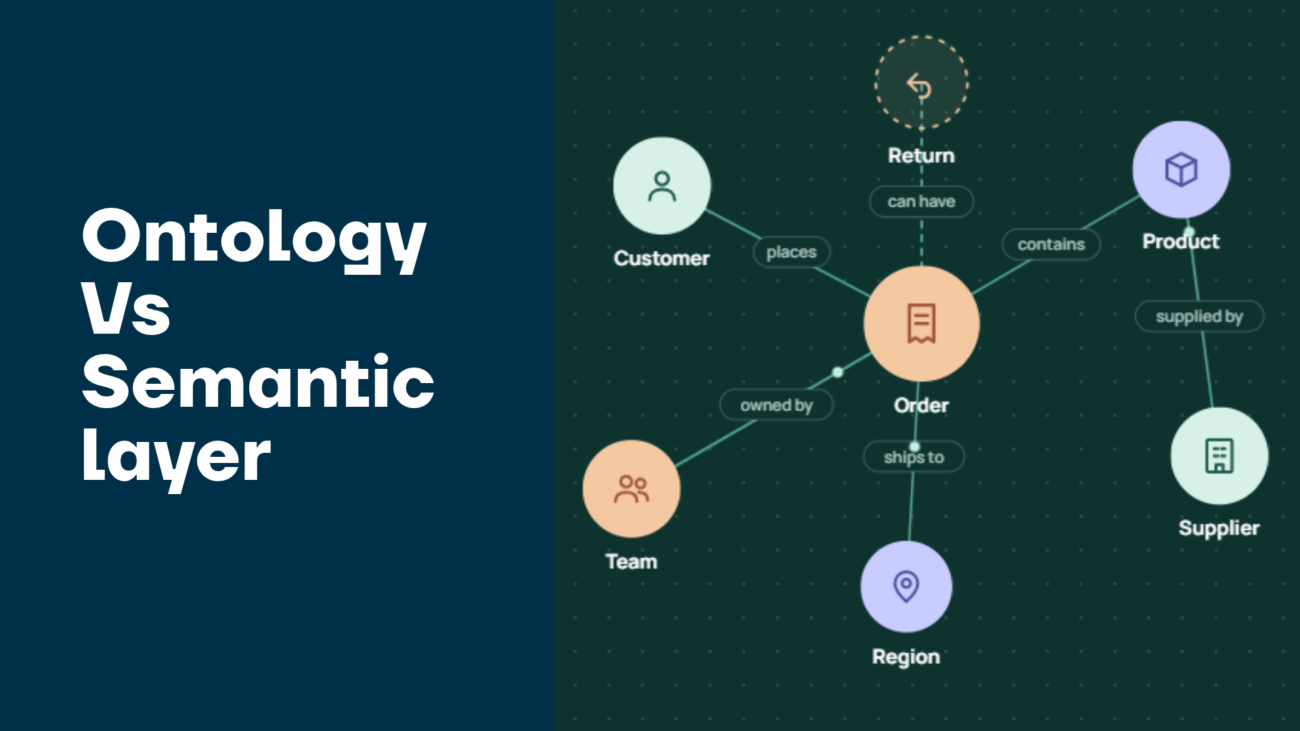
- Retail: Customer places Order, Order contains Product, Product is supplied by Supplier, Order ships to Region, and Order can have a Return.
- Healthcare: Patients and appointments, linked to providers, treatments and billing.
- Insurance and finance: Accounts, claims, invoices and payments.
- Manufacturing and supply chain: Suppliers, purchases, products and locations.
- Professional services: Projects, resources, timesheets and invoices.
- Logistics: Shipments, delivery exceptions, vehicles, drivers and routes.
The same pattern repeats: identify the entities that matter, define how they relate, and connect each to its data.
How to build a business ontology: a practical approach
You do not need to model your entire company on day one. A focused start is easier to get right.
- Pick a domain or question. Start with one department or one business problem, such as order-to-cash or delivery performance.
- List the core entities. Identify the people, assets, events, and processes involved. Customer, Order, Invoice, and Payment are common starting points.
- Define the relationships. Write each connection as a simple sentence: an Order is billed through an Invoice.
- Assign a data source to each entity. Choose the semantic layer that provides the data for each entity, even when entities come from different systems.
- Review with business users. Check that the model uses language your teams recognize.
- Expand gradually. Add entities and domains as the model proves useful.
Benefits of using a business ontology for business intelligence
- Makes data understandable. Users see business concepts, not technical structures.
- Keeps context connected. Information from different systems is related in a way that reflects how work, records, and outcomes fit together.
- Supports consistent decisions. Teams share a common vocabulary for exploring performance and discussing results.
- Strengthens AI analysis. AI follows defined relationships across entities and semantic layers to trace contributing factors and highlight insights with meaningful business impact.
Frequently asked questions
What is a business ontology in analytics?
A business ontology is a structured model of the concepts, entities, events and relationships a business cares about. In analytics, it connects those business ideas to the data that represents them.
What is the difference between an ontology and a semantic layer?
An ontology describes business concepts and how they relate to each other. A semantic layer defines and organizes the data itself. In Grafieks, you model entities first and assign a semantic layer as the data source for each entity.
Can an ontology use more than one semantic layer?
Yes. Different entities in the same ontology can use different semantic layers and still be connected through business relationships.
Can a business ontology support different industries and departments?
Yes. An ontology can model entities, processes, and relationships for any industry, business domain, or department. Examples include customers and orders in sales, accounts and invoices in finance, or products and locations in operations.
How does an ontology help AI find business insights?
An ontology gives AI a map of business entities and their relationships. AI can follow relevant paths across entities and semantic layers to investigate a question, trace contributing factors, and highlight insights that matter.
Conclusion
A semantic layer and a business ontology solve different halves of the same problem. The semantic layer makes your data consistent and understandable. The ontology connects the business concepts behind that data, across teams and systems, so people and AI can see how everything fits together.
If you want AI-powered analytics that goes beyond surface answers, giving it that connected business context is a strong place to start.
Ready to model your business? Explore Grafieks Ontology or talk to our team to see how entity-first modeling can connect your industry, domains, and teams.
